
Updated
Our verdict: The Walter Writes AI detector is our pick for a free first check across the 3 model families named on its product page: ChatGPT, Claude and Gemini. Product coverage was checked November 9, 2026. Read the completed result as an estimate about the submitted passage, then inspect its claims, sources and available drafts. A detector percentage is different from a measured accuracy rate and cannot establish authorship by itself.
| Your need | Use Walter for | Check next |
|---|---|---|
| Review a draft | An additional automated signal | Claims, citations and writing history |
| Understand a percentage | The labelled result for the submitted passage | Whether the label describes AI or human likelihood |
| Compare detectors | One result on an unchanged sample | The other tool’s score definition and input |
| Evaluate accuracy | A consistent set of known-origin samples | False positives, missed AI and uncertain outcomes separately |
What does the Walter Writes AI detector do?
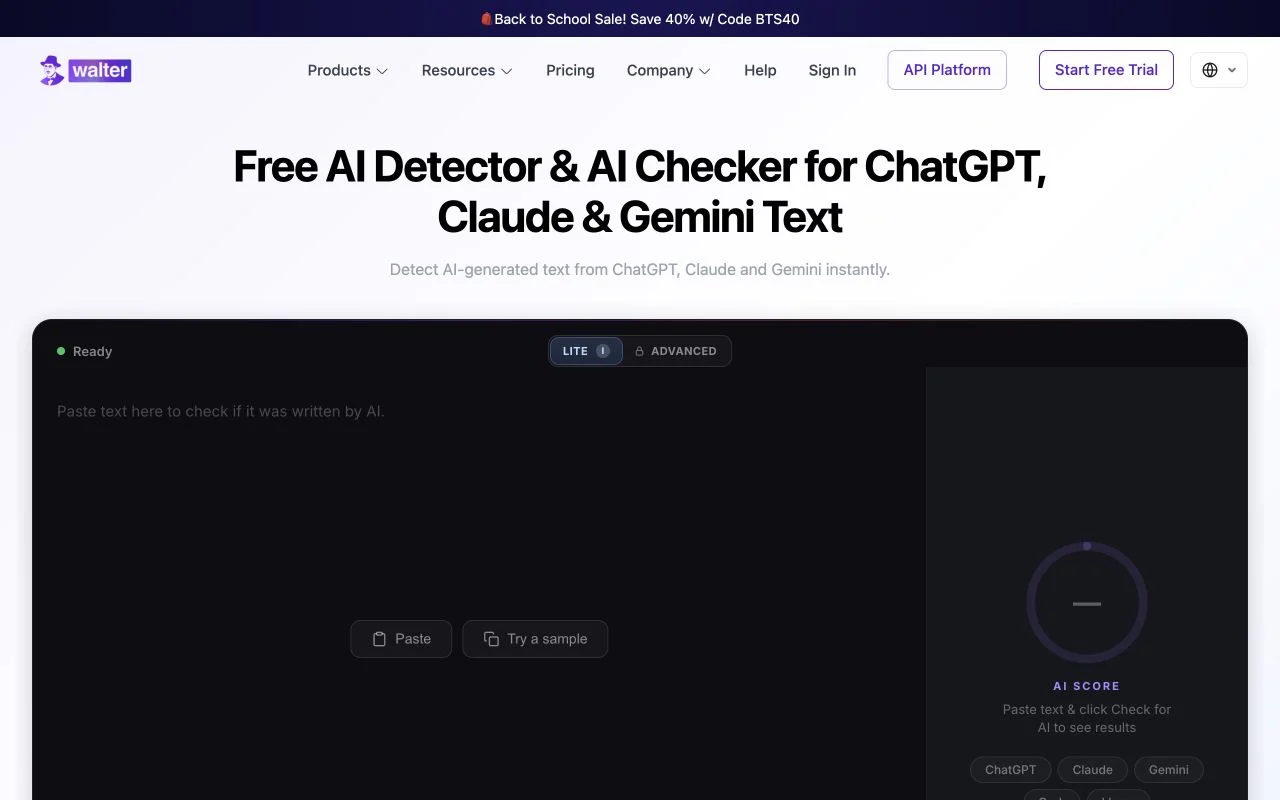
The Walter Writes AI detector is presented as a text checker for material from ChatGPT, Claude and Gemini. Walter’s current product page describes a percentage-style output and advertises free checks. That makes the product accessible for a writer or editor who wants an initial signal while reviewing a draft.
Keep the task precise. You are asking a classifier to assess the exact passage you submit. You are not obtaining a record of the author’s actions, the tools used during drafting or permission to publish the material. Those questions require additional information outside the detector response.
For the broader product and its rewriting features, start with our Walter Writes review. This article focuses on how to interpret and evaluate the detector rather than treating all Walter features as a single score.
How accurate is Walter Writes AI detector?
A meaningful accuracy claim needs text with known provenance, a defined scoring threshold and a record of every result. “The detector returned a human score” describes a classification. “The detector is accurate” is a claim about how often classifications agree with independently established labels across a stated sample.
When evaluating Walter for your work, keep human-written controls and AI-generated material in separate groups. A system that misses generated text has one problem; a system that incorrectly flags a person’s writing has another. Combining both into a headline percentage can hide the error most important to your use case.
Mixed drafts need their own category. A document containing human writing, quoted generated material and revisions cannot automatically be assigned a clean binary label. Record how the draft was created and decide in advance what the evaluation is intended to measure. Otherwise, disagreements can come from the label rather than the detector.
The research paper Testing of Detection Tools for AI-Generated Text examined errors and changes to text across a collection of earlier tools. Its findings motivate careful evaluation, but its historical results should not be copied into a current Walter review as Walter’s performance.
What does a Walter detector percentage mean?
Read the label immediately beside the number. An AI-likelihood display and a human-likeness display can run in opposite directions. Record the wording as well as the value, particularly when comparing a screenshot with another service’s report.
A score on a passage is not automatically the percentage of sentences an author generated, nor is it a count of policy violations. It also does not tell you whether the passage is factually correct, well sourced or useful to a reader. A fabricated citation can appear in prose that receives a low AI estimate.
Keep an unchanged copy of the input. If you remove headings, shorten the passage or edit its wording between checks, you are comparing results on different material. That may be useful for studying an edit, but it should be recorded as a different test rather than reported as unexplained inconsistency.
Why can Walter and another checker disagree?
Services can use different models, input processing and score definitions. Compare results only after confirming that the same complete text reached both systems. A partial upload, missing paragraph or different language setting can change the question being asked.
If the reports disagree, inspect the passage and the supporting evidence instead of taking a majority vote. Similar classifiers can share weaknesses. Agreement between tools therefore does not have the same evidential value as an independently saved draft, a checked source or an explanation of how the argument developed.
Our guide to checking AI writing sets detector checks alongside other review methods. For a product-specific school comparison, see Walter Writes versus Turnitin.
A repeatable way to evaluate Walter on your text
- Define the use case. Choose the type of writing you actually review. Do not use only short promotional snippets to evaluate a workflow built around long essays.
- Establish provenance. Save the original human drafts or the AI model, prompt and unedited generated output. Separate mixed authorship.
- Freeze the input. Give each sample an identifier and preserve its exact text. Record language, length and content type.
- Capture the result. Save the score, label, date and any error or uncertain state. Use the same classification rule across the set.
- Inspect errors. Review human false positives and missed AI separately. Keep difficult samples in the results rather than removing them after seeing the output.
The value of this procedure is traceability. If a colleague asks why a result was counted as correct, you can show the original label and rule. If the service changes, a dated sample set also allows a meaningful comparison with a later run.
Where Walter fits in an editorial workflow
Walter is most useful as a prompt for closer reading, especially when you already have a draft to review and want a quick additional signal. Start with the text’s purpose: is the argument supported, are names correct and do quotations match their sources? The detector can complement that work without becoming the decision-maker.
For a disputed student submission, a client-authorship concern or a high-stakes accusation, use the relevant review process. Turnitin’s guidance for educators treats an AI report as one data point alongside other information. The same distinction helps prevent a Walter result being stretched into a conclusion it cannot independently support.
What to check before submitting a document
Read Walter’s privacy policy and confirm that you may share the text. A public draft you own is a better evaluation sample than a private client file. Retain the original locally and record exactly which excerpt you checked.
If a check fails, save the error separately from a completed result. A blank output, timeout or loading state is not a human classification. Consult our practical Walter guide for organizing a check and recording useful support details.
Method and source date
Walter’s detector page and its visible product description were checked on November 9, 2026. The interpretation framework above distinguishes passage scores, known-origin evaluation and human review. OpenAI’s classifier retirement notice provides another example of why results belong to a specific system and period rather than the broad category “AI detector.”
Walter Writes AI detector: which result should you act on?
| What you see | What it tells you | Next step |
|---|---|---|
| A completed score with an AI label | The system’s assessment of the text it processed | Read the passage and confirm the exact input before drawing a conclusion |
| A completed score with a human label | A different interpretation direction from an AI-labelled display | Keep the label beside the value when recording or comparing results |
| An error, empty result or unfinished request | The check has not produced a usable classification | Record the error and use the official help route |
Best for: an additional signal when reviewing a passage you can share. Main limitation: an AI-pattern estimate does not supply a document’s writing history. Access: Walter’s current detector page advertises free checking; read the current interface instructions before submitting text.
Keep the input and the result together
If an editor checks only an introduction, the resulting record should say “introduction excerpt.” It should not be filed as a verdict about the full article. Keep the passage, the date and the displayed label together. When another person reviews the decision, that record lets them distinguish a disagreement about the text from a disagreement about the number.
When a sample is edited, preserve the revised passage separately. That makes the comparison answerable: the new result describes a changed input. For document provenance, ask what drafts and sources exist; for quality, ask whether the claims are accurate. Those checks remain useful even when the detector estimate is inconclusive.
How this guide reaches its recommendation
The editorial criteria are task fit, access, interpretation and the evidence a reader needs to make a decision. Product descriptions establish available features; the examples show how to review a draft or a report. Performance conclusions require results tied to the actual samples, products and dates. Keep those measures separate when comparing any review.
Spotted an outdated product detail? Send a correction to AI Text Detector with the page address and a link to the current source.
Explore the Walter Writes guides
Frequently asked questions
Is Walter Writes AI detector accurate?
Evaluate it on known-origin samples that match your language and writing task. Keep false positives on human text separate from missed AI text. A percentage returned for one passage is a detector output, not a measured accuracy rate.
Is the Walter AI detector free?
Walter’s detector page advertises free checks. Open the official detector to confirm the current interface and access conditions. Keep detector access separate from the humanizer trial or any paid rewriting allowance.
Does Walter detect ChatGPT text?
Walter markets the detector for ChatGPT, Claude and Gemini text. Recognition of a named model is a product claim; evaluate performance on the model versions, prompts and writing types relevant to your use case.
Does a low Walter AI score prove I wrote the text?
No. A low score describes the detector’s assessment of that passage. It does not establish the history of the document. Drafts, source notes and an explanation of the writing process address a different kind of evidence.
Can Walter falsely flag human writing?
False positives are a relevant possibility when using AI-writing classifiers. Keep human-written control samples in an evaluation and inspect any flagged passage before drawing a conclusion about a person or their work.
Why does Walter disagree with GPTZero?
The services may use different models, input handling and score labels. First confirm that both received the same text, then read the result definitions. A disagreement calls for investigation rather than automatically treating either service as ground truth.
Is Walter’s score the same as a Turnitin score?
No. A Walter result comes from Walter’s system and input. A Turnitin report comes from Turnitin’s processing and report definitions. One output cannot be used as a substitute for the other product’s report.
Should I rewrite until the detector says human?
Use revisions to improve accuracy, clarity and the requirements of your task. Repeatedly changing text to chase a label can damage meaning and makes results harder to compare. Keep the original and review each accepted change.