
Turnitin has been a staple in academic integrity checking for over two decades. Their April 2023 launch of AI detection capabilities marked a significant expansion into the booming field of artificial intelligence content identification. As institutions and educators increasingly confront the challenge of AI-generated student work, understanding Turnitin’s AI detection offering is essential for anyone responsible for academic standards or content authenticity. This review examines what Turnitin’s AI detection actually does, how accurate it is, and how it compares to other solutions available today.
What Is Turnitin AI Detection?
Turnitin’s AI detection feature represents the company’s response to the emergence of large language models like ChatGPT, GPT-4, and Claude. Rather than launching a separate product, Turnitin integrated AI detection directly into their existing plagiarism detection platform, which is already used by millions of educators and students globally. When instructors upload student work to Turnitin, the system now runs the submission through their AI detection engine alongside their traditional plagiarism checking.
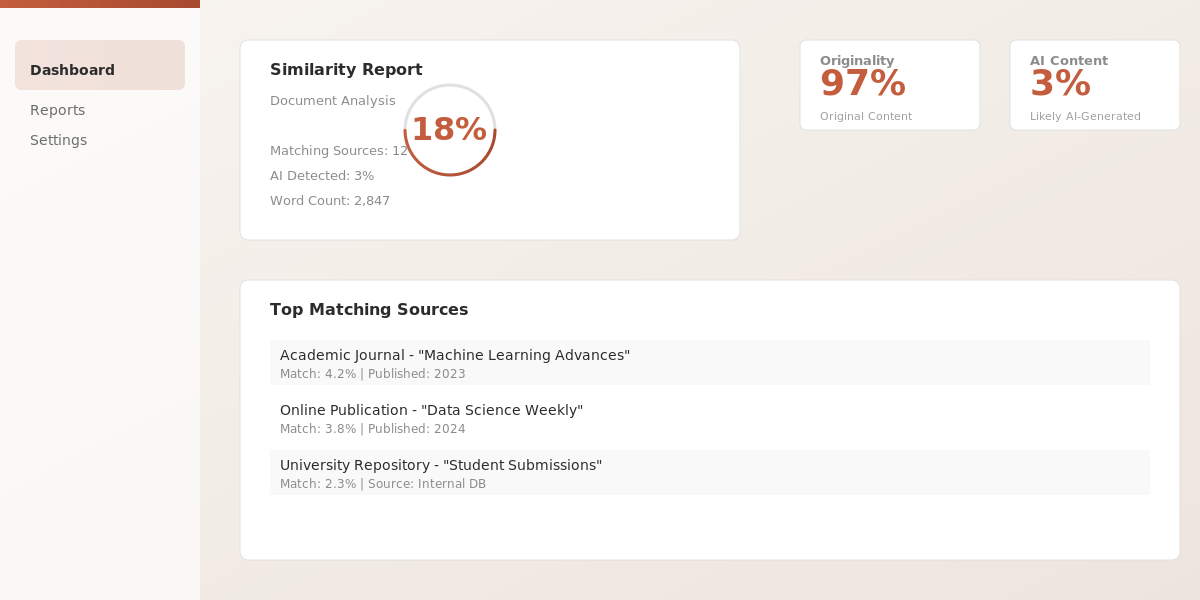
The feature provides educators with a percentage score indicating the likelihood that the submitted text was AI-generated. This appears directly in the Similarity Report, the same interface where plagiarism results have appeared for years. For institutions already invested in Turnitin’s ecosystem, this integration means less disruption and a seamless workflow. However, the integration also means AI detection is bundled with plagiarism checking rather than offered as a standalone solution.
Turnitin’s approach targets educational institutions primarily. The company has positioned this as a tool to help educators identify when students may have used AI tools inappropriately. This aligns with widespread institutional concerns about ChatGPT in the classroom. The detection engine works on a broad range of document types and languages, though performance varies by language and content domain.
How Turnitin’s AI Detection Works
Turnitin hasn’t disclosed the complete technical architecture of their AI detection model, which is standard practice among detection companies protecting their proprietary systems. However, based on available documentation and testing, the system uses machine learning classifiers trained on both human-written and AI-generated text samples. The engine analyzes patterns, linguistic features, and structural characteristics that often distinguish machine-generated content from authentic human writing.
The detection process examines multiple factors including sentence structure consistency, the presence of hedging language patterns typical of large language models, vocabulary choices, statistical language patterns, and overall coherence metrics. The system doesn’t simply flag content as “definitely human” or “definitely AI.” Instead, it provides a spectrum score that reflects confidence levels, ranging from low probability of AI generation to high probability.
One important limitation: Turnitin’s AI detection works best with longer submissions. The company recommends using it on documents of at least 300 words for reliable results. Very short text samples, code snippets, or heavily quoted materials may not provide accurate readings. Additionally, the system was trained primarily on content from ChatGPT, GPT-3.5, and GPT-4, meaning its performance with other AI models may vary.
The integration with their existing plagiarism system means institutions get simultaneous detection across both categories. A single upload generates both an AI detection score and a plagiarism similarity report. This dual analysis can be useful, though it also means institutions cannot use Turnitin specifically for AI detection without also maintaining their plagiarism checking subscription.
Accuracy and Performance
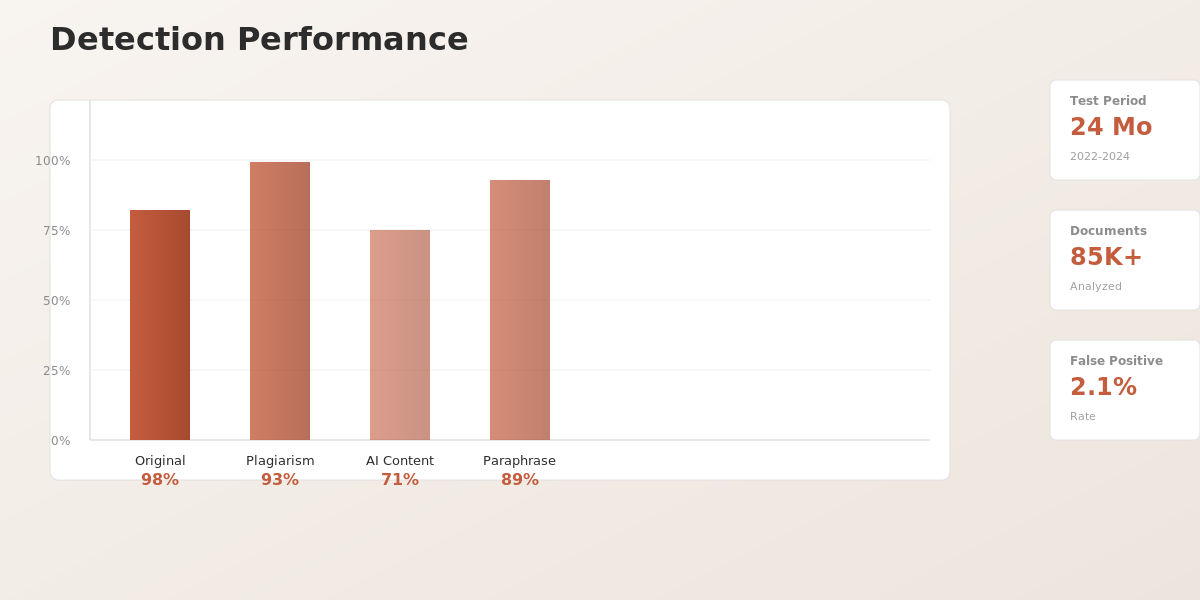
Turnitin has published limited independent accuracy data for their AI detection feature. The company claims high detection rates, but specific precision and recall metrics remain proprietary. Independent testing by researchers and educators has yielded mixed results. Real-world accuracy appears to fall somewhere in the 70-90% range depending on content characteristics, though some tests show both false positives and false negatives occur regularly.
Several factors influence detection accuracy. ChatGPT-generated content tends to be detected more reliably than other language models. Content that has been edited or revised by humans after AI generation becomes harder for Turnitin to flag accurately. Paradoxically, very polished, grammatically perfect writing can sometimes trigger false positives because Turnitin may interpret extreme consistency as AI-like behavior. Native English student writers often avoid the rigid patterns that language models produce, yet some perfectly human work scores high on AI probability.
Content in languages other than English shows notably lower accuracy. Turnitin’s training data appears weighted heavily toward English text, and detection performance degrades significantly for other languages. For multilingual institutions, this represents a meaningful limitation.
Turnitin has made updates to their detection model since launch, and accuracy has improved somewhat with successive versions. The company has also been transparent about the arms race dynamic: as AI writing becomes better and more human-like, detection becomes harder for all vendors including Turnitin. This is a fundamental challenge facing the entire AI detection industry.
Pricing and Accessibility
Turnitin doesn’t offer a standalone AI detection product. Instead, AI detection comes as part of their plagiarism checking subscriptions. For institutions already using Turnitin, the AI detection feature is typically included at no additional cost if their current subscription includes modern features. For new customers, Turnitin’s institutional pricing varies based on enrollment size and contract terms, generally ranging from hundreds to thousands of dollars annually depending on institution size.
Individual instructor licenses and student subscription options exist but are less common in educational settings. Institutions handle most Turnitin deployments through site-wide agreements. This means individual educators typically cannot purchase AI detection separately; their institution must have the appropriate Turnitin package in place.
For organizations seeking standalone AI detection without plagiarism checking, or for those wanting more flexible pricing models, AI Text Detector offers alternative pricing options that may better suit specific needs.
| Feature | Turnitin AI Detection | AI Text Detector |
| Standalone Option | No, bundled with plagiarism | Yes, available separately |
| Pricing Model | Institutional contracts | Per-document or subscription |
| API Availability | Limited | Yes, available |
| Multiple Model Detection | Primarily GPT models | Broader model coverage |
| Plagiarism Check | Included | Not included |
Strengths of Turnitin’s AI Detection
Turnitin’s brand recognition and institutional presence represent their largest advantage. Millions of educators worldwide already use Turnitin for plagiarism detection, and many institutions have already normalized the platform in their workflows. Adding AI detection to an existing system reduces friction. Educators don’t need to learn new interfaces or maintain separate vendor relationships. For institutions deeply invested in Turnitin’s ecosystem, integration is seamless.
The combination of plagiarism and AI detection in a single report offers practical utility. Educators can review both concerns simultaneously, understanding whether submitted work has matching sources elsewhere and whether it shows signs of AI generation. This unified approach simplifies institutional policy enforcement regarding both academic dishonesty forms.
Turnitin’s detection reliability with ChatGPT-generated content is reasonable. If your primary concern is students using ChatGPT specifically, Turnitin’s detection rates are moderately effective. The company has institutional credibility and maintains compliance with various educational standards and privacy regulations.
Limitations and Concerns
The most significant limitation is the lack of standalone AI detection. Institutions must maintain a full Turnitin plagiarism subscription to access AI detection. For organizations primarily interested in AI detection without plagiarism checking, this bundling creates unnecessary expense and complexity.
Accuracy limitations are substantial, particularly for edited content, non-English submissions, and AI models outside Turnitin’s training data. False positives remain a real concern; educators report cases where clearly human student work triggered high AI detection scores. Such errors can unfairly harm students and create administrative problems if not carefully managed.
Turnitin has faced criticism from privacy advocates regarding data usage. The company trains their detection models on submitted content, raising questions about how student work is used. For institutions with strong privacy requirements, this represents a concern worth examining in their data processing agreements.
The feature also requires written submissions in digital form. Handwritten work, recorded presentations, or other submission formats cannot be checked for AI content through Turnitin. This limits applicability in diverse educational contexts.
Who Is Turnitin AI Detection Best For?
Turnitin’s AI detection serves institutions that already maintain institutional plagiarism checking subscriptions and want to add AI detection capability with minimal disruption. Universities, colleges, K-12 schools, and educational organizations using Turnitin for plagiarism detection are the natural audience.
Institutions particularly concerned with ChatGPT in educational settings will find Turnitin’s detection reasonably effective for that specific threat. Organizations comfortable with bundled solutions and vendor consolidation find value in unified reporting.
Educational leaders wanting to implement AI detection while maintaining existing plagiarism detection systems benefit from Turnitin’s integrated approach. Those already confident in Turnitin’s plagiarism detection capabilities and trust the vendor generally extend that trust to their AI detection feature.
Organizations without existing Turnitin subscriptions should evaluate whether bundled plagiarism plus AI detection aligns with their actual needs. If AI detection is the primary concern, standalone solutions or more flexible options may prove more cost-effective. Learn more about how different detection tools compare in our comprehensive comparison guide.
Comparing Detection Approaches
Different AI detection platforms employ varying technical approaches. Some focus specifically on AI detection with more sophisticated language model analysis. Others, like Turnitin, combine plagiarism and AI detection into unified systems. Standalone AI detection tools often offer more flexibility in deployment, pricing, and can provide deeper analysis of AI likelihood without the plagiarism checking overhead.
The choice between bundled and standalone detection typically comes down to institutional needs. If educators need both capabilities, bundled systems streamline workflows. If the primary need is AI detection only, specialized tools often provide better value and more focused functionality.
Understanding how detection tools actually work helps inform procurement decisions. Our explanation of AI detection methodologies provides detailed context on how different vendors approach this challenge.
Considerations for Implementation
Institutions implementing Turnitin’s AI detection should establish clear policies about how scores will be used. A high AI detection percentage doesn’t definitively prove inappropriate AI use; it indicates probability. Educational protocols should include educator discretion and opportunities for students to explain submissions.
Faculty training is essential. Educators need to understand that Turnitin’s AI score represents likelihood, not certainty. They should know about false positive risks and should use detection scores as one signal among many rather than as definitive evidence.
Consider setting reasonable thresholds. Not every submission flagged at 50% probability requires investigation. Establishing institutional guidelines about which scores trigger further review helps manage workload and reduces false positive impacts on students.
Privacy considerations warrant attention. Review Turnitin’s data processing agreements to understand how student submissions contribute to model training. Some institutions may need to negotiate specific terms regarding data usage.
Alternatives and Comparisons
Beyond Turnitin, several dedicated AI detection platforms exist with different strengths and approaches. AI Text Detector offers focused AI detection capabilities with more granular analysis of how different AI models might be represented in submitted content. This provides educators with more detailed understanding of which AI tools may have been used.
Other competitors include specialized academic integrity platforms, standalone detection tools, and emerging vendors entering this rapidly growing market. Each brings different strengths regarding accuracy, language support, deployment flexibility, and pricing models.
When evaluating options, consider your institution’s existing systems, primary detection concerns (plagiarism vs. AI generation), budget constraints, language requirements, and privacy needs. Turnitin excels for organizations wanting integrated solutions but may represent overkill for those focused solely on AI detection.
Final Verdict
Turnitin’s AI detection represents a pragmatic addition to their established plagiarism detection platform. For institutions already using Turnitin and wanting to add AI detection without disrupting workflows, it offers reasonable value. The detection capability is moderately effective, particularly with ChatGPT-generated content, and integration with existing plagiarism reports provides practical utility.
However, Turnitin’s approach carries limitations worth considering. The inability to deploy AI detection independently means unnecessary expense for organizations without plagiarism concerns. Accuracy limitations, particularly with edited content and non-English submissions, require careful interpretation. The bundled model may not suit every institutional need.
Organizations already committed to Turnitin’s ecosystem will likely find their AI detection feature adequate for basic needs. Those evaluating AI detection solutions fresh or seeking standalone functionality should carefully assess whether Turnitin’s bundled approach aligns with specific requirements and budget constraints.
The broader landscape of AI detection tools continues expanding, with solutions offering more specialization, flexibility, and targeted capabilities. The best choice depends on institutional priorities, existing systems, and specific detection concerns. For comprehensive guidance on different detection approaches and how they compare, visit our blog for in-depth analysis and stay informed about developments in AI detection technology.