
Updated
Short answer
Do not use a ChatGPT authorship guess as proof that text was generated by AI. OpenAI retired its separate AI-text classifier in July 2023 because of low accuracy. A conversational response about a paragraph is not a validated report of who wrote it.
| Question | Useful scope | Limit |
|---|---|---|
| Is this paragraph clear? | Suggest edits and identify ambiguity | The writer must judge the advice |
| Which claims need sources? | Point out assertions to verify | Suggested sources need independent checking |
| Does this resemble a generic template? | Describe visible stylistic features | Style does not establish authorship |
| Who wrote this paragraph? | Usually cannot establish provenance from wording alone | No access to the writing process |
| Will a school detector flag it? | Cannot inspect a private institutional report | A prediction is not the report |
A confident explanation is not an authorship record
ChatGPT can comment on style, structure and clarity. It can also produce a plausible explanation for an authorship guess. That explanation is generated from the prompt and the available context; it is not a record of the document’s composition. Fluent reasoning should not be mistaken for access to evidence the system has never seen.
A passage can sound formulaic for many reasons. The task may require a standard structure, the writer may be learning a language, or the subject may use fixed terminology. Those possibilities do not prove human authorship either. They explain why style alone cannot carry the whole conclusion.
If you ask a chatbot whether a paragraph is AI-written, first identify what you want to learn. A request for editing feedback can be useful. A request for an accusation about a writer requires evidence that a conversational guess does not supply. Keep those tasks separate.
Why the retired OpenAI classifier matters
OpenAI’s classifier was a separate product from a normal ChatGPT conversation. Its withdrawal illustrates a limitation of automated authorship classification, but it does not provide a measured accuracy rate for every current detector or for ChatGPT. Do not transfer old product results to a different system.
The dated announcement is useful context because it names the product and the decision made about it. It should not be turned into a claim that all detection is impossible, that every current tool performs identically, or that a chatbot has secretly replaced the withdrawn service.
When evaluating any detector, ask which version was tested, what samples were used and how errors were counted. A vendor’s general marketing statement and an independently documented test answer different questions. Neither should be substituted for a review of an individual writer’s work.
How to use ChatGPT for writing feedback responsibly
Ask about the argument rather than asking it to certify authorship. For example, request an explanation of where a paragraph lacks evidence or where the conclusion does not follow. Then verify the feedback against your sources. Retain the writer’s intended meaning and voice when making changes.
Do not upload confidential manuscripts or student work without permission. Check the applicable data policy and the assignment’s permitted-use rules. A tool being familiar does not remove the need to decide whether a particular document can be shared.
If assistance is allowed, record what it contributed. That might include brainstorming, feedback or a suggested reorganisation. A clear description of the work is more useful than trying to make the final prose look as though no tool was ever involved.
What would a documented repeat-prompt example show?
A useful demonstration would retain the exact paragraph, prompt, conversation context, date and model label available to the tester. It would ask the same question in separate conversations and preserve the outputs. Without those records, an anecdote about inconsistent answers is not a reproducible example.
Even a completed demonstration would have a narrow scope. It could show what happened to that passage under those conditions. It would not establish the accuracy of ChatGPT across all writing or prove that any other detector is better. A real benchmark needs a broader, labelled dataset and a stated method.
We have not run the demonstration described here. No output, score or consistency result is being reported. The future example should help readers understand uncertainty rather than serve as a staged claim about a product.
A better response to an authorship concern
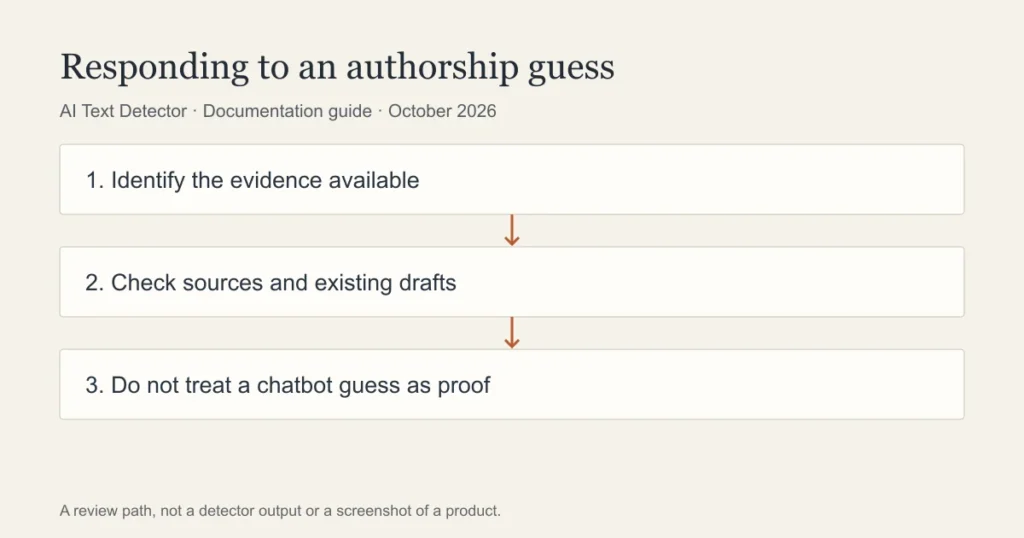
Read the work and inspect its sources. Ask the writer how the argument developed and consider relevant drafts under the applicable process. If a detector is involved, name it and explain the specific passage that raised the concern. Do not tell a writer that a chatbot knows who wrote their text.
Walter Writes offers a free detector, which would provide a separate estimate. It cannot verify a ChatGPT conversation or reveal a school’s private report. A second check is a reason to inspect the writing, not a substitute for evidence about its development.
A detector score should not be the only evidence in a decision about a person. Clear sourcing, an understandable argument and an honest account of permitted assistance are more useful goals than persuading a chatbot to return a preferred label.
Frequently asked questions
Can ChatGPT recognise text it wrote earlier?
Do not treat a claim of recognition as a provenance record. The relevant evidence is the actual conversation or writing history, subject to privacy and context. A guess based on style cannot establish that a particular output came from a particular session.
Is OpenAI’s old classifier still available?
OpenAI announced its withdrawal in July 2023. That separate service should not be confused with a normal ChatGPT conversation. Check the dated announcement rather than following an old tutorial that promises access to the retired tool.
Should I rewrite until ChatGPT says my text is human?
No. That does not establish authorship or improve an unsupported argument. Revise for accuracy, clarity and your own meaning. Follow the relevant policy and keep a truthful record of any assistance used.
Sources
Choose the relevant next step
For an evidence-based response and separate checker access, read methods for reviewing writing concerns, detector accuracy and missing evidence, and free detector access and limits. Each guide separates documented features from an estimate or assumption about a writer.